Pavement Structural Testing
Why Structural Testing Matters
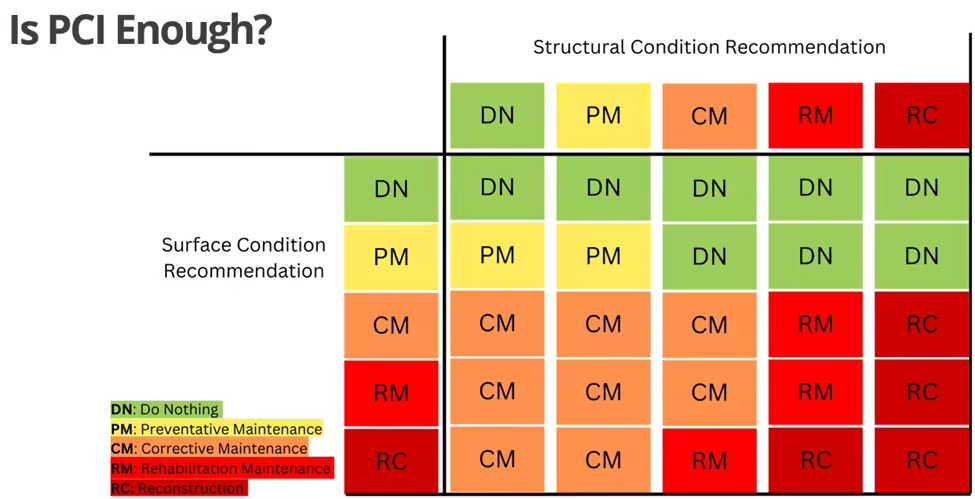
The structure of a road cannot be seen, yet it is the single most significant factor in the long-term performance of pavement. Relying on surface condition alone leaves the most important part of the decision invisible.
Every preservation treatment and minor rehabilitation is a potential waste of money if the road cannot support the traffic loads. Structural data changes that. It tells you whether a problem is confined to the surface or rooted in the subgrade or subbase, so treatments target the actual need instead of the symptom.
A few examples of what that means in practice:

Alligator cracking does not always indicate structural failure. Age-related cracking from an oxidized, brittle binder may be structurally adequate and only require resurfacing rather than full rehabilitation. Structural testing identifies this and can substantially reduce treatment costs.
Structural strength is especially critical on roads carrying higher and heavier truck traffic, where inadequate structure can deteriorate far faster than expected.

Alligator cracking does not always indicate structural failure. Age-related cracking from an oxidized, brittle binder may be structurally adequate and only require resurfacing rather than full rehabilitation. Structural testing identifies this and can substantially reduce treatment costs.
Both of our in-house structural testing methods, TSDD and FastFWD, are nondestructive. They deliver insight into subsurface distress and structural condition without disturbing the pavement, which is especially valuable for roads with a history of milling and overlays, varying soil conditions, or other environmental factors.
The data becomes even more powerful when combined with reliable traffic data, particularly heavy vehicle composition and volumes (AADT). Our structural adequacy plots turn that data into a clear visual picture of subsurface performance, pinpointing underperforming roadways and loss of subgrade support that is invisible from the surface. Paired with detailed, actionable reporting tailored to your needs, this data-driven approach targets maintenance and rehabilitation where it is genuinely needed and raises the efficiency of your entire pavement management program.
How Structural Data Enhances PMS Decisions
Traffic Speed Deflection Device (TSDD)
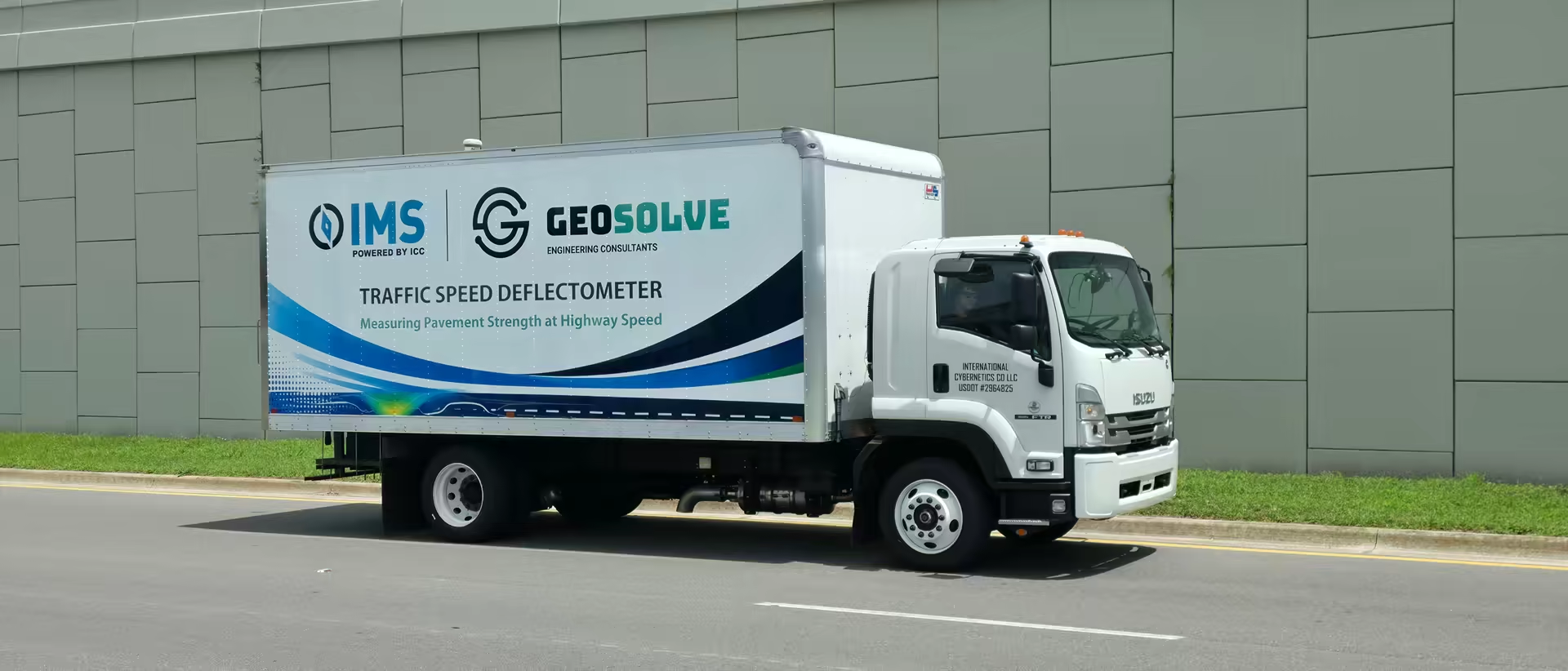
Our TSDD collects the structural data you need while operating at normal traffic speeds, with no traffic control and no lane closures required. That makes safety a leading advantage: crews and the traveling public are never exposed to a stationary work zone, and your network keeps moving while data is collected.
Just as important, TSDD data is continuous. Where FastFWD captures point data at each drop location, the TSDD measures continuously along the roadway using 16 Doppler sensors covering the leading and trailing bowls, making it especially effective at catching localized soft spots that point-based testing can miss.
Our TSDD is based on the latest Gen5 technology for maximum repeatability, accuracy, and resolution. It is uniquely deployed on a smaller truck, reducing the operational footprint and improving access to secondary routes and constrained corridors. We deliver TSDD data in partnership with GeoSolve using a unique, innovative method for converting TSDD data into actionable, FWD-equivalent metrics, so the results apply directly to your current practices. The technology is fully validated, backed by a proprietary calibration that does not require sensor removal from the vehicle. The purpose-built lasers used in the TSDD have low noise levels, making the pavement deflections measurable even on stiff pavements.
Capabilities and Benefits

Traffic-speed measurements with no traffic control required

Complete survey coverage on interstates, primary and secondary highways, arterials, and local streets

FWD-equivalent structural outputs for screening and project scoping

Actionable analytics to support planning, prioritization, and treatment limits

Flexible reporting intervals for network analysis or targeted maintenance

Excel and GIS deliverables for easy review and system integration
From Deflections to Decisions
Every survey moves through a rigorous workflow: field collection at traffic speed with real-time health and quality monitoring, automated and manual QA/QC to validate completeness and synchronization before analysis, conversion to FWD-equivalent deflection bowls with rigorous fit and compatibility screening, and structural metrics aligned to your roadway network for confident decision support. Deliverables are DOT-ready, including open data delivery, quality documentation aligned to your project-specific DQMP, georeferenced outputs suitable for PMS and GIS integration, and synchronized right-of-way imagery where cameras are available.
The result is data you can act on: visual reports for engineers, senior managers, and elected officials; identification of weak segments and pavement failure modes; the right treatments applied and ineffective ones avoided; support for maintenance and rehabilitation planning and treatment-length optimization; and estimates of remaining service life to develop a 0 to 30 year maintenance program.
Optional add-ons: high-resolution (approximately 1 ft) analysis for maintenance targeting, pavement surface imaging with LCMS-2, right-of-way imaging, Ground Penetrating Radar (GPR), and calibration and validation support such as FWD tie-ins and control sites.
Fast-Falling Weight Deflectometer (FastFWD)
The FastFWD simulates traffic loading by applying a dynamic load to the pavement surface and measuring its response, or deflection. This data is crucial for assessing a pavement’s load-carrying capacity and remaining service life. The FastFWD meets AASHTO R 32 specifications.
We incorporate the resulting Structural Index (SI) into each roadway’s Overall Pavement Condition Index (OCI) score, giving you a comprehensive assessment of pavement health.
The SI expresses structural integrity on a scale of 0 to 100:

SI > 75: Structurally adequate. May be treated with lightweight surface treatments or thin overlays.

SI 50 to 75: Typically requires additional pavement thickness.

SI < 50: Generally needs reconstruction and increased base and pavement thickness.

Ground Penetrating Radar (GPR)
GPR frequently complements structural deflection data for a further enhanced pavement condition assessment. Collected via ASTM 4748-10, GPR data can be combined with other nondestructive methods to determine the remaining life of pavements, structural number, pavement modulus, and subgrade modulus. It can also assess bridge decks, concrete, utility locating and mapping, and other project-specific use cases.
We provide GPR through a trusted partner, allowing us to fold this capability into a complete structural assessment when your project calls for it.
Advanced Structural Testing
Our clients


About company
Contact Us
- 10630 75th Street Largo, FL 33777
- +1 727-547-0696 USA
- +1 289-807-4371 CAN
- sales@icc-ims.com
© 2024 International Cybernetics Company, LP (ICC)